
Cracking after potting is usually a stress-management problem, not only a material brand problem. The crack may appear because the cured resin, the product geometry, and the thermal environment are fighting each other more than the original process review expected.
- Question answered: Why does resin cracking happen after potting, and how should manufacturers prevent it?
- Best for: potting engineers, reliability teams, quality engineers, and manufacturers dealing with cracked epoxy or resin encapsulation after cure or thermal cycling.
- Direct answer: Resin cracking after potting usually comes from cure shrinkage, excessive rigidity, thermal expansion mismatch, large section depth, trapped stress, poor material selection, or a cure schedule that creates uneven internal stress.
- Buyer readiness: L4 RFQ Ready to L5 Deployment
- Next step: Prepare defect photos, cross-sections, cure schedule, section dimensions, substrate details, and thermal cycle conditions before requesting a process review.
Industrial Context and Buyer Readiness
This article maps cracking-related search intent to the real process and design interactions that create stress after potting.
| Context | Details |
|---|---|
| Topic cluster | Potting Defect Cluster; Material Selection Cluster; EEAT Troubleshooting Content |
| Buyer readiness level | L4 RFQ Ready to L5 Deployment |
| Application scenario | electronics encapsulation, transformer potting, sensor sealing, automotive module protection, LED driver encapsulation |
| Material scope | epoxy, filled epoxy, rigid encapsulation resin, flexible potting compounds, silicone systems |
| Process scope | potting, cure scheduling, thermal cycling, section design, stress control, material selection |
| Equipment scope | potting machine, meter mix system, vacuum potting unit, oven, dispensing valve |
| Defect or risk focus | cracks, crazing, delamination, brittle cure, internal stress, and long-term reliability risk |
| Production goal | lower internal stress, better thermal cycling survival, and a more durable encapsulation design |
Entity Map for This Topic
| Entity group | Details |
|---|---|
| Material entities | epoxy resin, filled epoxy, silicone potting, flexible resin |
| Process entities | potting, cure, thermal cycling, shrinkage control, stress relief |
| Equipment entities | potting machine, meter mix system, oven, vacuum potting system |
| Industry entities | electronics, automotive, EV, LED, industrial controls |
| Defect entities | resin cracking, stress crack, delamination, brittle cure, edge fracture |
| Measurement entities | section depth, cure temperature, hardness, thermal cycle range, shrinkage, CTE mismatch |
Contents
- Direct answer
- Why this matters
- Application scenario matrix
- Engineering review points
- Decision layer
- Checklist
- FAQ
Why Does Resin Cracking Happen After Potting?
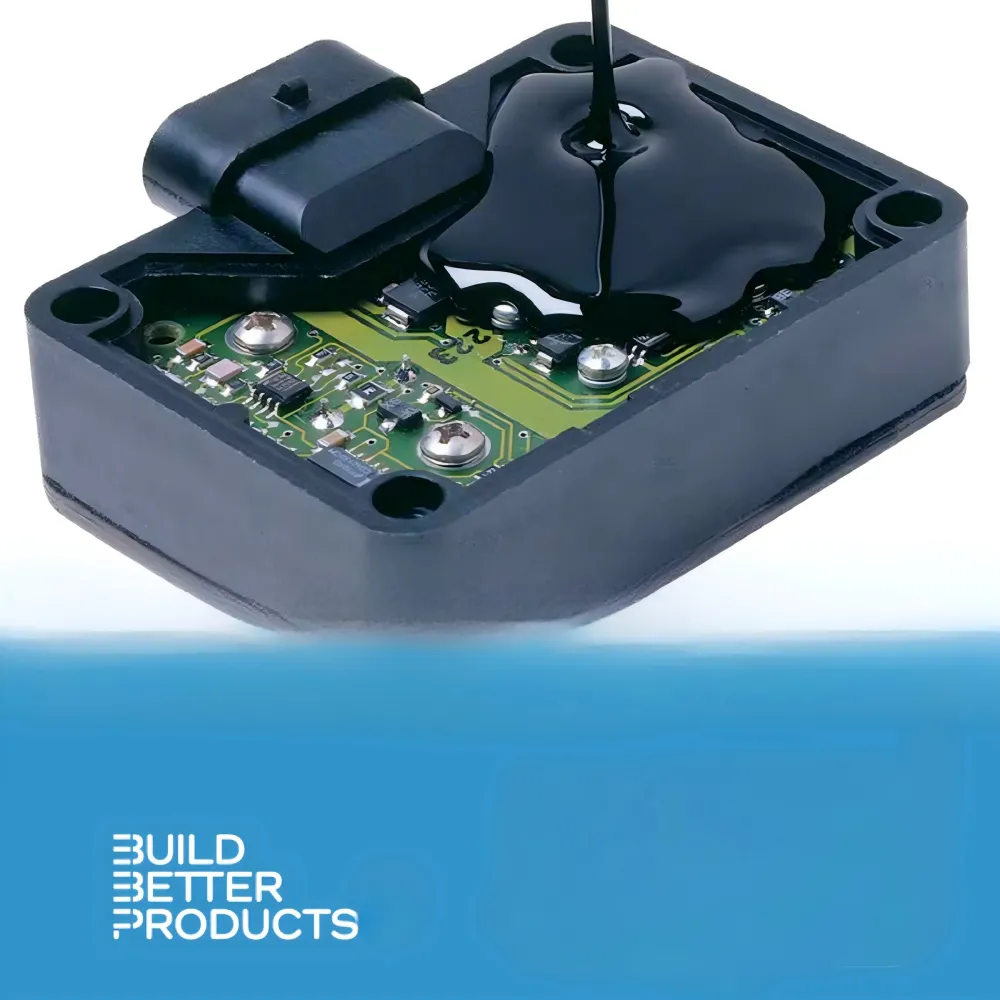
A potting resin cracks when the stress generated during cure or later thermal cycling exceeds what the material and assembly can tolerate. That stress may come from shrinkage, rigidity, trapped voids, thick sections, or expansion mismatch between the resin and the housed components.
This is why crack troubleshooting should review both chemistry and mechanical design. A resin can pass simple cure tests and still crack later because the geometry or environment creates stress that was never fully validated.
Why This Topic Matters in Real Production
Cracks can open a path for moisture, reduce insulation, weaken support, and create long-term reliability failures.
In products exposed to thermal cycling or vibration, a small crack can grow across service life until the whole encapsulation loses function.
Buyers often discover that preventing cracks requires not only material change but also different cure logic or fill strategy.
Common Reasons Resin Cracks After Potting
| Cause | What happens | Typical sign | Corrective action |
|---|---|---|---|
| Cure shrinkage | Resin pulls inward as it cures | surface or edge cracks | review lower-stress formulations and cure schedule |
| CTE mismatch | Resin and substrate expand differently | cracks after thermal cycling | reconsider material flexibility and design gap |
| Section too thick | heat and shrinkage concentrate in one mass | center stress or edge fracture | review staged fill and section control |
| Material too rigid | assembly cannot absorb movement | brittle cracking or corner fracture | evaluate softer or stress-relieving alternatives |
| Void-related stress concentration | hidden bubbles create weak points | cracks start near void pockets | improve vacuum, fill path, and cross-section quality |
| Over-aggressive cure profile | rapid cure creates internal stress gradients | early or post-cure cracking | smooth the cure ramp and review oven profile |
Crack prevention usually improves when teams stop looking only at the resin brand and start reviewing the whole stress environment of the assembly.
Application Scenario Matrix
| Application | Typical crack risk | Main driver | What to validate first |
|---|---|---|---|
| Transformer encapsulation | bulk resin cracking | large section and shrinkage | section depth and cure ramp |
| Sensor modules | edge cracking around housing | CTE mismatch | material flexibility and interface design |
| LED drivers | surface cracks after cure | filled resin stress | cure schedule and thermal profile |
| Automotive electronics | thermal-cycle cracking | temperature swing and rigidity | thermal cycling with real assembly |
| Power modules | corner fracture near components | local heat and stress concentration | geometry and material hardness |
The application matrix matters because different crack patterns point toward different combinations of material, geometry, and cure stress.
Engineering Review Points
A practical crack analysis should focus on where the crack starts and when it appears.
- Map the crack location and determine whether it starts at the edge, center, interface, or around a component.
- Check whether the crack appears immediately after cure or only after thermal cycling or aging.
- Review section depth, total mass, and whether the fill was completed in one shot.
- Compare the resin hardness and shrinkage tendency with the product’s expansion behavior.
- Inspect cross-sections for voids or weak interfaces near the crack origin.
- Review the cure ramp and post-cure profile for stress concentration risk.
That sequence usually reveals whether the main lever is material flexibility, cure profile, fill geometry, or void reduction.
Quantification Rules Engineers Should Watch
Useful crack prevention work should be based on measurable process and design facts.
- section depth and shot weight
- cure temperature and ramp profile
- hardness or modulus target
- thermal cycle range and number of cycles
- presence or absence of voids in cross-section
- substrate and housing material combination
- time to crack appearance after cure
Without those values, cracking discussions usually become too vague to solve reliably.
Decision Layer: Material, Process, Equipment, or Procurement?
| If you see this | Most likely layer | Why | Next step |
|---|---|---|---|
| Cracks appear immediately after cure | Process and cure profile | internal shrinkage stress may be too high | review cure ramp and section depth |
| Cracks appear only after thermal cycling | Material and design interaction | CTE mismatch or excessive rigidity is likely | review softer or more compliant systems |
| Cracks start near hidden bubbles | Process quality | voids are creating stress concentration | improve fill path and degassing |
| Only one product geometry cracks | Design-specific stress | the assembly shape is the key driver | review local thickness and corners |
| Different resin lots behave differently | Material control | shrinkage or cure behavior may vary | review supplier data and lot traceability |
Crack prevention often requires a combined material and process decision rather than a one-line root cause.
Checklist Before Reviewing a Cracking Problem
| Checklist item | Why it matters |
|---|---|
| Take photos of crack location | The origin point is a major clue |
| Record when the crack appears | Time-to-failure separates cure stress from service stress |
| Record section depth and shot weight | Large masses change shrinkage behavior |
| Record cure and post-cure profile | Thermal stress often starts here |
| Record substrate and housing materials | Expansion mismatch matters in potting |
| Check cross-section for voids | Hidden bubbles can trigger local fracture |
| Compare cracked and non-cracked samples | A differential review often shows the missing factor faster |
That evidence makes it much easier to decide whether the next action belongs in chemistry, process, design, or equipment setup.
Related OBO Precision Guides
- Why Does Incomplete Curing Happen in Epoxy Potting?
- Why Does Potting Create Bubbles And How Can You Fix It?
- Conformal Coating vs Potting: When Should You Use Each Process?
- Contact OBO Precision for an engineering review
Defect Cluster Navigation
This article is part of OBO Precision’s potting and dispensing defect cluster. Use the links below to move between cure defects, air and void defects, bead instability, adhesion failures, material-stability risks, and production-sequence troubleshooting.
- Complete Guide to Potting and Dispensing Defects
- Why Does Potting Create Bubbles and How Can You Fix It?
- How to Prevent Glue Stringing in Automatic Dispensing?
- Why Does Overflow Happen in Potting and Dispensing Applications?
- Why Does Poor Adhesion Happen After Dispensing or Potting?
- Why Does Incomplete Curing Happen in Epoxy Potting?
- Why Does Resin Cracking Happen After Potting?
- Why Does a Potting Sample Have a Soft Center After Cure?
- Why Does Epoxy Potting Cure Too Slowly in Production?
- Why Does Over-Cure Brittleness Happen in Resin Encapsulation?
- Why Does Uneven Hardness Happen After Potting?
- Why Does Wrong Ratio Appear After a Material Change in 2K Dispensing?
- Why Do Air Voids Form in Deep Potting Cavities?
- Why Do Bubbles Form Around Tall PCB Components During Potting?
- Why Do Voids Still Remain After Vacuum Potting?
- Why Does Trapped Air Stay Inside Sensor Encapsulation?
- Why Does Foam Appear in Silicone Dispensing?
- Why Does Uneven Bead Width Happen in Gasket Dispensing?
- Why Does Bead Collapse Happen After Dispensing?
- Why Do Start-Stop Marks Appear in Dispensing Paths?
- Why Does Dot Size Inconsistency Happen in Automatic Dispensing?
- Why Does Material Tailing Happen After a Bead Stops?
- Why Does Delamination Happen After Potting?
- Why Does Poor Wetting Happen on Low Surface Energy Plastics?
- Why Does Edge Lift Happen After Adhesive Dispensing?
- Why Does Primer Failure Happen in Industrial Bonding?
- Why Does Bond Failure Appear After Thermal Cycling?
- Why Does Filler Settlement Happen in Thermal Epoxy During Production?
- Why Does Viscosity Drift Happen During Production?
- Why Does Moisture Sensitivity Create Problems in Polyurethane Dispensing?
- Why Does Resin Separation Happen in Feed Tanks?
- Why Does Shelf-Life-Related Instability Happen in Dispensing?
- Why Does Startup Scrap Happen in 2K Dispensing?
- Why Do Defects Increase After Material Refill?
- Why Does Dispensing Drift Happen Across Long Production Runs?
- Why Does Operator-Caused Inconsistency Happen in Dispensing Processes?
- Why Do Production Defects Increase After a Line Speed Increase?
Frequently Asked Questions
Does cracking always mean the resin quality is poor?
No. Cracking often comes from the interaction between resin properties, geometry, cure stress, and service environment.
Can a softer material solve every cracking problem?
Not always. A softer material may reduce stress, but it still has to meet adhesion, protection, and process requirements.
Why do thick sections crack more easily?
Large sections concentrate shrinkage and thermal stress and can create a more uneven cure condition.
Should we change cure temperature first?
Sometimes, but only after reviewing whether the real issue is cure stress, section design, or material rigidity mismatch.
Need Help Preventing Resin Cracking After Potting?
If your potted assembly is cracking after cure or thermal cycling, send the section drawing, crack photos, cure profile, and material type through our contact page for an engineering review. Contact OBO Precision.
References